The Preschool Around the Corner Might Be the Wrong One for Your Child
The Shortcut Most Parents Take — And Why It Makes Sense
For most parents with children of preschool age, the process of choosing the right one for your child usually starts with a Google Search and then a deeper Google Maps search. You input terms like ‘Best preschool in HSR Layout’, or ‘preschools in HSR’ and then almost automatically click on the Map results to check which ones are the closest to home. Because, let’s be honest for a second, choosing a preschool for your child involves you drawing a mental radius around your home, shortlisting whatever falls inside it, and then visiting a couple of places to check that they seem clean, safe and affordable before making a decision.
This is peak rational parenting. The logistics of a school run with a three-year-old — drop-off times, pickup windows, traffic, the younger sibling who also needs to be somewhere — are genuinely not trivial. Proximity matters. It always will.
But here's what's worth pausing on: the preschool years are also, by a significant margin, the most developmentally consequential years of your child's education. And if that's true, and the evidence suggests it strongly is, then it's worth asking whether convenience is the right primary filter for a decision this important. Not to make you feel guilty about the choice you're leaning towards. But to make sure you're leaning towards it with the full picture in front of you.
What's Actually Happening in These Years
The case for taking early childhood education seriously starts with a fact that tends to get quoted and then forgotten: somewhere between 80 and 90 percent of brain development happens before the age of six. The foundational learning that occurs between ages two and six isn't preparatory to real education. It is real education — arguably the most intensive and consequential stretch of it your child will ever experience.
During these years, children aren't just acquiring information. They're forming the mental habits and emotional frameworks that will govern how they approach learning for the rest of their lives. The child who learns, in these years, that confusion is interesting rather than threatening will carry that orientation into every hard problem they face at ten, at fifteen, at twenty-five. The child who learns that wrong answers are embarrassing, or that questions slow things down, will carry that too.
This is what preschool brain development actually means in practice. Not just cognitive milestones, but the formation of a child's relationship with not-knowing. With trying. With the gap between where they are and where the answer is. A strong start in these years doesn't just make Class 1 easier. It makes difficulty itself feel more navigable — for decades.
The Difference Between a School That's Safe and a School That's Right
Most parents, when they visit a preschool, are reading for safety. Is it clean? Does it feel secure? Are the children happy? These are the right questions — but they're the floor, not the ceiling. Almost every school that's still operating clears this bar. The harder question, the one that actually separates a good preschool environment from a great one, is what the school does with curiosity.
Watch what happens when a child asks a question the teacher wasn't expecting. Watch what happens when a child gets something wrong. Watch what happens when a child wants to keep doing something after the scheduled activity has ended. These moments — ordinary, unremarkable, happening dozens of times a day in every classroom — are where the culture of the school actually lives.
A school can have beautiful preschool facilities — well-designed activity zones, sensory learning areas, interactive classrooms — and still, in these small daily moments, teach children that learning is something that happens to them rather than something they do. The infrastructure sets the stage. The culture determines what plays out on it.
The right environment isn't just one where children feel physically safe. It's one where they feel intellectually safe — where a wrong answer isn't a small failure, where a question that goes beyond the activity is welcomed rather than managed, where the natural drive to understand things is treated as the most valuable thing in the room.
Additional Reading:
What to Look For in the People, Not Just the Place
The single biggest determinant of a preschool's quality isn't its facilities or its curriculum framework. It's the preschool teaching quality — specifically, what its teachers do in the unscripted moments.
There's a meaningful difference between a qualified preschool teacher who manages children well and one who is genuinely curious about what they're thinking. Both can run a tidy classroom. Only one will respond to a three-year-old's unexpected observation about why the sky looks different today with something other than a gentle redirect back to the activity.
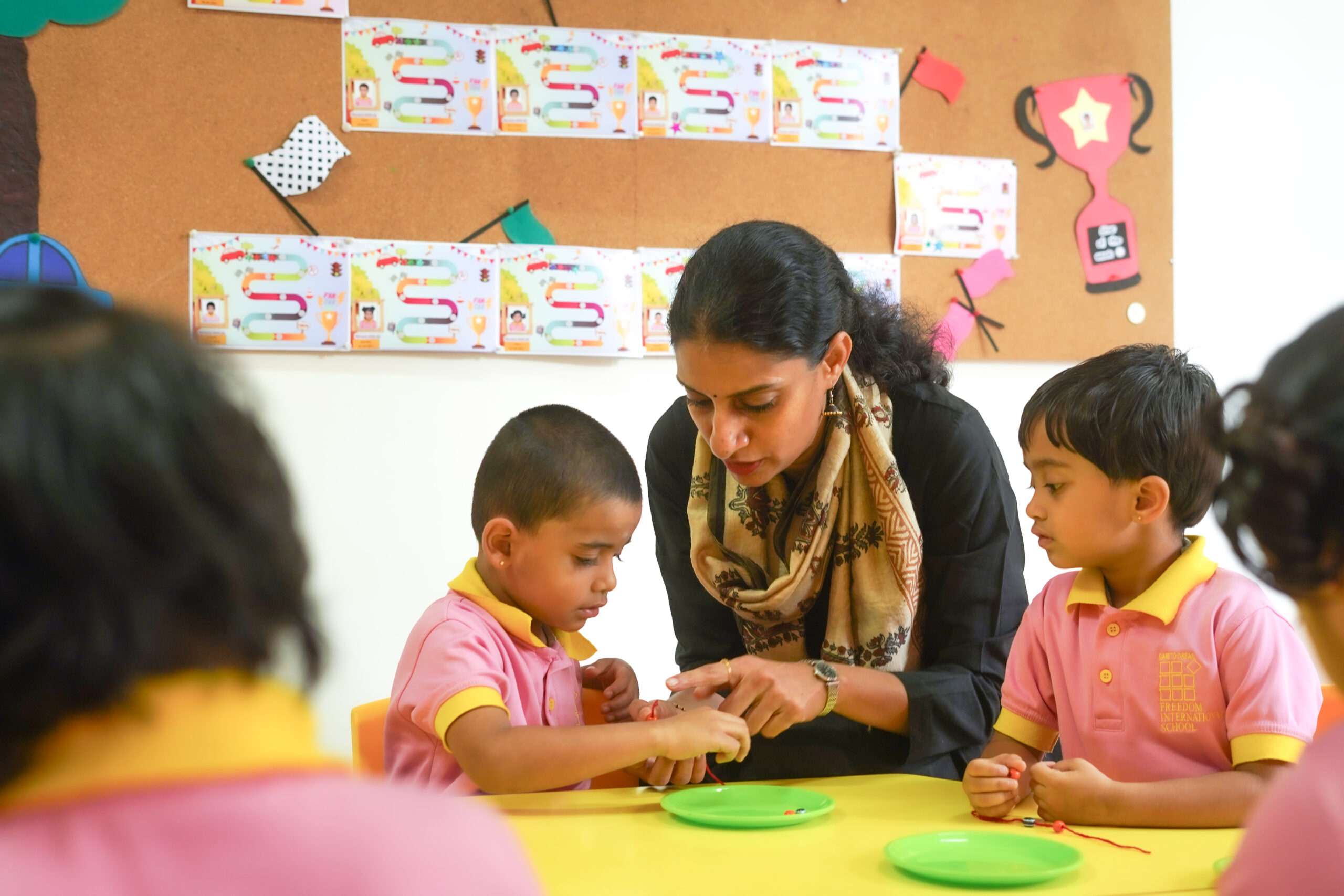
The best early childhood educators share a few specific qualities that are worth looking for when you visit. They talk to children at eye level — not just physically, but in terms of taking their ideas seriously. They ask questions back rather than simply answering. They model not-knowing: "I'm not sure — what do you think?" is a sentence that, said consistently, teaches children that uncertainty is the beginning of learning rather than an admission of failure. And they notice — genuinely notice — when a child is working something out, rather than just checking whether they've arrived at the right answer.
These qualities don't appear on a credential list. They're visible in a twenty-minute classroom observation, if you know what you're looking for.
The Question Worth Asking Before You Decide
There's a version of choosing the right preschool that happens on open days and guided tours, and there's a version that happens on ordinary Tuesdays. The open day version is curated — the rooms are arranged, the teachers are prepared, the children are doing something photogenic. It tells you something, but not everything.
If you can, visit on a regular day. Arrive at a time when nothing special is scheduled. Watch a transition — from one activity to the next, or from indoor to outdoor time. Transitions are where classroom culture becomes most visible, because they're the moments nobody planned for. How does the teacher handle the child who isn't ready to move on? How does the room manage the unexpected?
Ask the school directly: "How do you handle it when a child asks a question you weren't expecting?" A school that has thought carefully about how to choose a preschool — from the inside, meaning a school that has genuinely interrogated its own practice — will have a specific, considered answer. A school that hasn't will give you something warm and circular.
The importance of preschool isn't just that it prepares children for formal schooling. It's that it forms the emotional and intellectual habits that formal schooling will either build on or spend years trying to repair. The right school gets this. And the right school will be able to show you — not just tell you — what that looks like on an ordinary Tuesday.
At Freedom International, we welcome exactly that kind of visit. Because the school we are on a random Tuesday is the same school we are on an open day. And that consistency, more than any prospectus, is what we'd like prospective parents to see.