The Best Thing Your Child Can Ever Ask
The Scene Every Parent Recognises
Let's imagine for a moment a scene that's going to play itself out in almost every home across the country in a month or so. CBSE exams over, mark sheets home, thoroughly discussed and debated. Now, let's also imagine that your child has put in the work and done well — a 90% plus in Science. You feel a quiet pride. All the effort and months (and money) spent on online classes, tuitions, and revision sessions has paid off.
Over dinner one evening, you ask your child how the term was and what they feel they really learned from a subject in the cbse syllabus they'd been studying all term. "Photosynthesis," they say. "The process by which plants make their food using sunlight." Word-for-word, exactly as it is said in the textbook. Further questions from you, though, go unanswered, or answered vaguely. "I don't need to worry about it anymore," your child says. "I've already finished the exams!"
You smile. But somewhere underneath, a small question surfaces: does my child actually understand this? Could they explain it to a younger sibling? Could they tell me why it matters? Could they take that knowledge somewhere new?Most of us push that question aside. The mark is good. The system worked. We move on.
But what if that quiet question deserves a louder answer?
How We Got Here
Here's the thing — Indian parents didn't arrive at their focus on marks by accident, and there's no judgment in saying that. For decades, academic scores were one of the very few reliable roads to opportunity. A good college, a stable career, a better life than the one before. The pressure that builds around board results and entrance exams isn't imaginary. JEE, NEET, the Class 10 and 12 boards — these shape real futures, and every parent in this country knows it. So cbse schools like FIS Bangalore and families made a perfectly understandable choice: focus on what gets measured. Teach to the test. Drill what will be asked. Reward the child who can reproduce the right answer, reliably, under pressure.
And it worked — in its own way. Children passed exams. Colleges were secured. But somewhere in the process, something quieter got crowded out. The child who once bounced home asking "but why does that happen" gradually learned to stop. Because in most classrooms, that question doesn't have a place. It won't be on the paper. It won't help the score. Move on.
The child who once bounced home asking "but why does that happen" gradually learned to stop asking questions. Because in most classrooms, that question won't be on the paper.
The Question That Changes Everything
Here's what's interesting, though — and what teachers and researchers who study how children actually learn will tell you: kids who understand why something works don't just enjoy school more. They remember it longer, apply it more flexibly, and more often than not, they handle the pressure of unfamiliar exam questions better than children who have only ever memorised what.
Curiosity isn't a personality trait that a lucky few are born with. It's a habit. And like any habit, it can be built — or it can be quietly discouraged until it disappears.
Think about a Class 6 student who's struggling with fractions. Standard classroom approach: here's the method, here are twenty problems, here's your mark. But this particular child keeps circling back — "Why do we flip the second fraction when we divide? That doesn't make sense to me." In most classrooms, that question gets a kind but firm redirection. "Don't worry about that. Just remember the rule. It'll come in the exam."
Now imagine the teacher pauses and says: "That's actually a brilliant question. Let's figure it out together."Something shifts. That child doesn't just learn fractions. They learn that their confusion is worth paying attention to — that it's the beginning of understanding, not a sign they're falling behind. They learn that school is a place where it's okay to think out loud.
And then they ask the next question. And the one after that. Over time, that habit of not settling for the surface becomes the engine of their academic life — not a distraction from it.
What This Looks Like Inside a CBSE Classroom
Let's be clear about something: CBSE is a rigorous, nationally respected curriculum. What doesn't get said often enough is that it also has real room for exactly this kind of teaching — room for inquiry, for conceptual understanding, for questions that go beyond the textbook. Most schools simply don't use that room, because drilling is faster and easier to standardise.
At Freedom International, we've made a deliberate choice to use it.
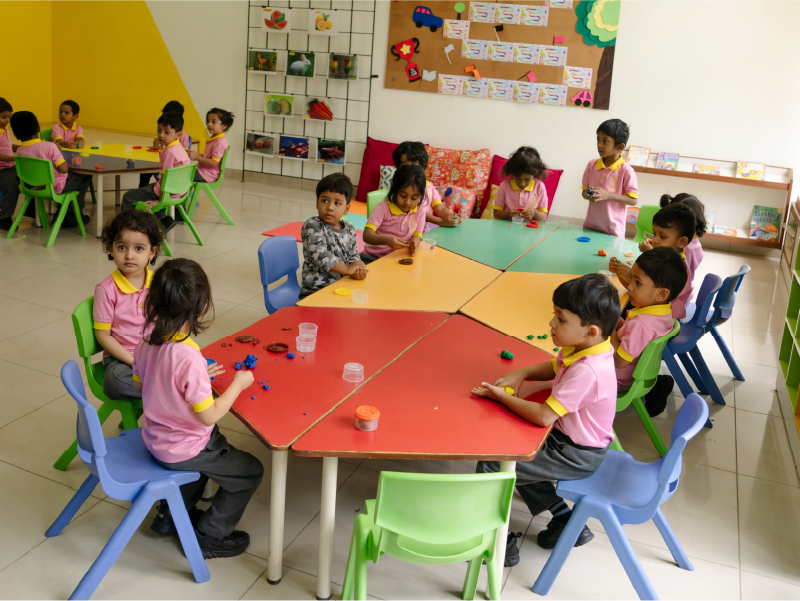
In a Class 4 EVS lesson on water conservation, we don't open with the textbook definition. We start with a question: "Why do you think some parts of India have enough water and others don't?" The answers that come back are messy and imperfect and entirely the children's own. But by the time the structured content arrives, they already have a reason to care about it. The information lands somewhere, because they were already looking for it.
In a Class 9 History class on the French Revolution, rather than asking students to list causes and effects, we ask: "If you were a farmer in France in 1789, what would have made you take to the streets?" Answering that question takes empathy, imagination, and real engagement with the material. It also, as it turns out, produces the kind of nuanced, reasoned answers that score well in board exams — because examiners can tell the difference between a student who understood history and one who memorised it.
The CBSE syllabus is the foundation. Curiosity is how we build on it.
What You Can Do at Home
The most powerful shift you can make at home is also the simplest: when your child asks you a question, try not to answer it straight away. Ask them what they think first. Not to catch them out — but because it signals something important: that their thinking matters, and that the question itself is worth sitting with. You don't need to know the answer either. "I'm not sure — how do you think we could find out?" is one of the most genuinely useful things a parent can say. When they come home with their marks, try slipping in one different question alongside the usual ones: "What was the most interesting thing you came across this week?" Not the highest-scoring subject. The most interesting. You might be surprised what comes up. And when they hit that familiar wall — "I don't know" — try not to treat it as the end of the conversation. It isn't. It's usually where the real one begins.
The Longer Game
The world your child will step into when they're done with school doesn't especially need people who can reproduce correct answers under timed conditions. It needs people who can sit with hard problems, ask the right questions, draw connections across very different fields, and keep learning long after the last exam is behind them.
Those aren't soft skills. They're the ones that matter most — and they're not built in spite of academic rigour. They're built through it, when the classroom is a place that treats curiosity as the point, not an inconvenience to be managed.
At Freedom International, that's not something we aspire to. It's something we work at every day — from the youngest children in primary school to students preparing for their board examinations. In the articles that follow, we'll show you exactly what that looks like at each stage: the approaches, the classroom moments, and the thinking behind the choices we make.
For now, we'll leave you with this.
The child who learns to ask better questions will always outgrow the child who only learned to memorise better answers.
That's the education we're building here. We're glad you're curious about it.