
How FIS Prepares Students for Major Entrance Exams after 12th
The Entrance Exam Your Child Is Really Preparing For
Here's something worth sitting with before the coaching brochures arrive and the preparation schedules for entrance exams take over: Preparations for every major entrance exam in India — whether you're thinking about how to prepare for JEE, how to prepare for NEET and CET, how to prepare for CLAT, or whether the goal is CUET, IPMAT, or NDA — involve testing for the same thing at its core.
Not how many chapters were covered. Not how many mock tests were attempted. Not even how many hours were logged in coaching classes. What these exams are actually testing is whether a student can think — clearly, independently, and under pressure — when a question arrives that doesn't look exactly like the ones they've practised.
JEE Advanced is notorious for this. The questions are deliberately constructed to defeat students who memorised methods without understanding why those methods work. NEET's biology questions increasingly require application and inference, not recall. CLAT's comprehension passages reward students who have spent years reading and reasoning carefully, not those who crammed legal reasoning in the final six months. CUET, now mandatory for central university admissions, tests conceptual clarity across subjects rather than the ability to reproduce syllabus content.
The student who arrives at the entrance exam cycle having spent years genuinely understanding what they learned — asking why things work, not just how to apply them — is in a fundamentally different position from the one who arrives having memorised the same content. The hours logged may be identical. The outcomes often aren't.
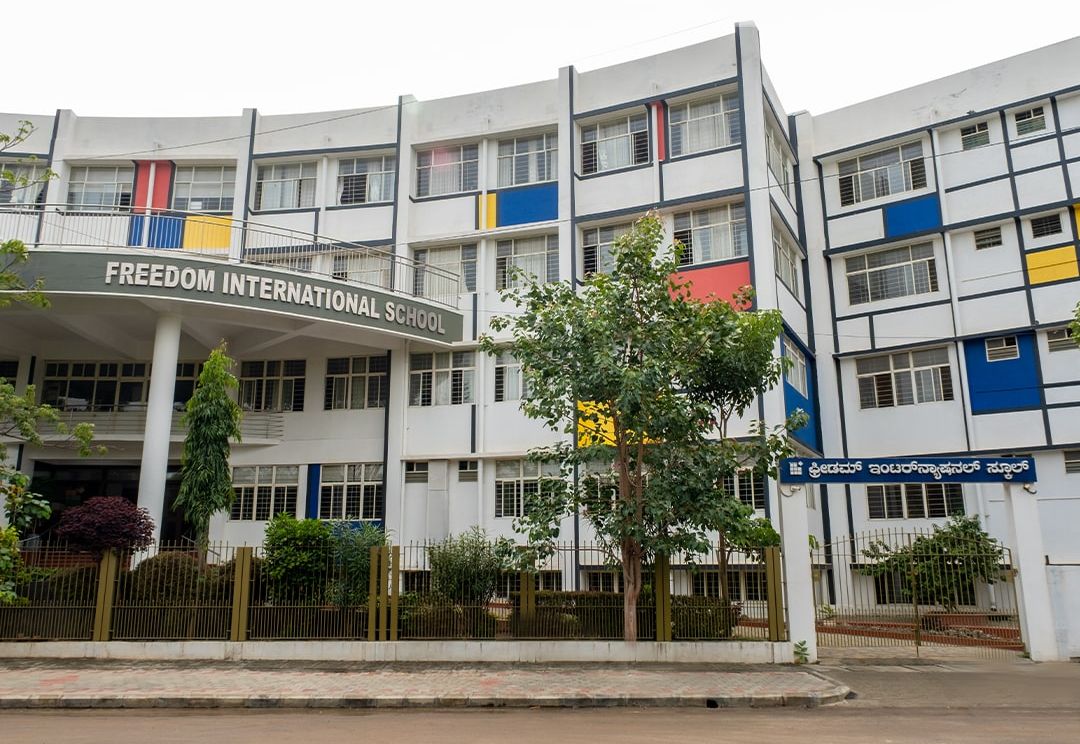
In the sections that follow, we’ll look at specifically how FIS, one of the top CBSE schools in HSR Layout, Bengaluru, builds that foundation across Classes 9 through 12.
Why Most Students Struggle With Entrance Exams
If you speak to any serious coaching institute off the record, most will tell you the same thing: the students who struggle most aren't the ones who didn't work hard enough. They're the ones whose foundational understanding was too thin to support the weight of what the exam actually demands.
This is an uncomfortable truth, because it points upstream — to the years of schooling before coaching began, not to the coaching itself. A student who spent Classes 9 and 10 in a classroom that treated the CBSE syllabus as a checklist to be covered rather than a framework to be understood arrives at Class 11 with a significant and largely invisible deficit. The content is there. The understanding underneath it often isn't.
Coaching can fill gaps in syllabus coverage. It can build exam speed and technique. It can expose students to question patterns they haven't seen before. What it cannot do — in two years, under pressure, alongside a demanding Class 11 and 12 curriculum — is rebuild the conceptual foundations that should have been laid in the four years before. That work has a window. And it closes faster than most parents realise.
What Strong Foundations Actually Look Like in a CBSE Senior Secondary Classroom
The phrase "strong foundation" gets used so often in school marketing that it's stopped meaning anything specific. So let's be concrete about what it actually looks like in the subjects that entrance exams test.
In Physics — the subject that separates JEE aspirants more than any other — a strong foundation means a student who knows not just how to apply Newton's laws but why they hold, where they break down, and what that tells us about the structure of the physical world. That understanding doesn't come from solving five hundred problems to the same method. It comes from a teacher who takes the question "but why does this work?" seriously enough to answer it, and from a classroom where that question is welcome rather than managed.
In Biology — the core of NEET preparation — rote memorisation of structures and processes will take a student only so far. The questions that determine whether a student lands a government MBBS seat or doesn't are the ones that require them to reason about biological systems they haven't memorised a specific answer for. That reasoning is built in classrooms where students are asked to predict, infer, and explain — not just recall.
In English — the foundation of CLAT, CUET, and IPMAT — the skills being tested are inference, critical reading, and the ability to construct a logical argument under time pressure. These aren't skills that materialise during exam preparation. They're built across years of reading, debating, writing, and being asked to defend a position. A student who has done this consistently from Class 8 onwards has a structural advantage in every reading-heavy exam they will ever face.
In Mathematics — the thread running through JEE, IPMAT, and most state CETs — the difference between a student who can solve familiar problems and one who can crack unfamiliar ones is almost always conceptual clarity. Not more practice. A deeper understanding of why the methods work.
At Freedom International, this is what we mean when we say we treat the CBSE syllabus as a floor rather than a ceiling. The syllabus sets the territory. We take students deeper into it than the exam requires — because that depth is exactly what the exam rewards.
What the Results Show
We're cautious about making claims on behalf of our students — their results belong to them, not to us. What we can say is that the approach we've described above produces students who are genuinely prepared for high-stakes examinations, not just familiar with their format.
In the most recent Class 12 cycle, Shatakshi Ray and Amal Manoj — both from the Science stream at Freedom International — achieved 99.58 and 99.57 percentile respectively in JEE Mains. These are not scores produced by coaching alone. At that percentile level, coaching is a given. What separates students at the 99th percentile from those at the 90th is the depth of conceptual understanding underneath the technique — the foundation that makes the coaching land.
Shatakshi Ray, Grade XII Science — 99.58 percentile, IIT JEE Mains
Amal Manoj, Grade XII Science — 99.57 percentile, IIT JEE Mains
In the Humanities stream, Asmita Goswami finished as the Bangalore topper for 2024, receiving recognition and a cash prize from the Bangalore Sahodaya Schools Complex. Shruthi Subramanian finished third in Bangalore in the same year, with the same recognition. These results matter for CLAT, CUET, and humanities-based competitive exams for the same reason: board performance at this level reflects the quality of conceptual engagement across subjects, not just exam preparation.
Asmita Goswami, Grade XII Humanities — Bangalore topper, 2024 — Sahodaya Schools Complex award
Shruthi Subramanian, Grade XII Humanities — Third place in Bangalore, 2024 — Sahodaya Schools Complex award
We offer these results not as a guarantee of what your child will achieve, but as evidence of what students who come through this environment are capable of when the foundation is right.
The School Transfer Question
Let's address the elephant in the room, because if you're reading this article there's a reasonable chance this is the question you actually came here to answer: my child's current school only goes to Class 10. They're in Class 9 or 10 right now. Is it too late to move to a school that goes through Class 12, and does it make a difference which school that is?
The honest answer is: no, it's not too late. And yes, it makes a significant difference which school.
A student moving to Freedom International in Class 9 has three full years before their first major entrance exam cycle — three years that, for a Science stream student thinking about how to prep for JEE or NEET, is exactly the window that makes the difference between surface familiarity and genuine readiness. That's enough time. A student moving at the start of Class 10 has two years before they're in the thick of Class 11 and 12 preparation. That's tighter, but it's still meaningful — especially because the Class 10 board year at FIS is taught in a way that builds the analytical foundations Class 11 will demand, rather than simply preparing for the board exam itself.
What a mid-school transfer does require is honesty about the adjustment period. Every school has a different culture, a different pace, and different expectations of what students bring to the classroom. A student moving from a school where the dominant mode was rote learning and exam drilling may find the first term at FIS genuinely challenging — not because the content is harder, but because the kind of engagement expected is different. That adjustment is real, and it's worth knowing about before you decide.
What it isn't is a reason not to move, if the current school's inability to take your child through to Class 12 was always going to require a transition anyway. The question isn't whether to make the transition — it's whether to make it to a school where the next three years will be spent building the foundations that entrance exams actually test, or to one where the same content will be covered faster and shallower in the interest of getting through the syllabus.
That choice has consequences that play out in exam halls, not in prospectuses.
The Question Worth Asking Before You Choose a Coaching Centre
Most parents of Class 9 and 10 students are already thinking about coaching — which institute, when to start, how many hours a week. That's a reasonable thing to be thinking about. But there's a prior question that tends not to get asked, because the answer requires looking at something less visible than a coaching schedule.
What is the school doing in the years before the coaching starts?
For a parent wondering how to prepare for CLAT, or how to give a JEE aspirant the best possible start, the answer almost always begins further back than the coaching centre. Coaching institutes are very good at what they do. The best ones in Bangalore are genuinely excellent — experienced faculty, rigorous question banks, structured preparation timelines. But they are working with the raw material that the school years produced. A student who arrives at coaching with deep conceptual clarity will absorb the technique quickly and apply it flexibly. A student who arrives with syllabus coverage but shallow understanding will spend a significant portion of their coaching time trying to fill gaps that should have been addressed years earlier.
The school doesn't get the credit when the coaching produces results. But the school is frequently responsible for whether the coaching can produce results at all.
At Freedom International, we think about our job in Classes 9 through 12 as building the conceptual depth that makes everything that follows — coaching, entrance exams, university, career — land on solid ground. The exams are the destination. We're in the business of building the road.